Transport Modelling
Transport Modelling involves a set of techniques used to represent, analyse, and predict the behaviour of mobility systems. It provides a realistic and quantitative understanding of how people and vehicles move through different urban environments such as squares, cycle paths, public transport lines, streets, railways, and other mobility contexts.
Through mathematical models, transport modelling identifies the key dynamics that shape travel behaviour: route choice, real and perceived costs (such as ticket price or travel time), as well as how these factors change over time or across different planning scenarios. They can simulate variable traffic conditions, infrastructure interventions, and demand management policies, enabling planners to predict their impacts.
Transport Modelling is an essential tool for decision-making. It enables designers to test future scenarios before implementation, identify critical issues, compare design alternatives, estimate benefits, and evaluate environmental and social impacts. It also supports the correct sizing of transport infrastructure and optimises both public and private transport services.
From strategic planning to detailed design, mobility modelling provides a coherent, data-driven, and replicable approach based on real data. It enables designers and decision-makers to develop transport networks that are safer, more efficient and sustainable, and truly user-oriented.
Strategic Macro Models
Meso Models
Micro Models
Pedestrian Models
Analytical Models
Strategic Macro Models
Macro-strategic transport models provide a comprehensive, aggregated view of mobility flows on a large scale, ranging from urban districts to regional and national areas. They are fundamental tools for long-term strategic planning, mobility policy evaluation, investment analysis, and future demand forecasting.
These models describe multimodal travel behaviour by incorporating interactions between modes of transport such as private cars, public transport, cycling, and walking.
Read moreUsing network balancing mathematical algorithms, they estimate how trips are generated, distributed, and assigned across different modes.
The most comprehensive structure for macro models is the four-stage model, comprising trip generation, trip distribution, mode choice, and assignment.
This approach makes it easy to compare scenarios and estimate the impacts on congestion and sustainability, providing a solid support for strategic decisions on transport infrastructure.
Read lessFour-stage model
Trip generation
Trip distribution
Demand forecasting
See the projects
![[:en]Mayo Clinic Rochester's macro-strategic transport model[:it]Modello di trasporto macro-strategico per Mayo Clinic Rochester[:]](https://www.mic-hub.com/wp-content/uploads/2024/11/MIC-HUB-Mayo-Clinic-Macro-scale-model.jpg)
![[:en]Macro-strategic transport model of the city centre of Padova[:it]Modello macro-strategico del centro di Padova[:]](https://www.mic-hub.com/wp-content/uploads/2025/01/MIC-HUB-SIR2-Padova_macro-model.jpg)
Meso Models
Meso models operate at an intermediate level, linking the strategic overview of macro models with the operational specifics of micro models.
They represent traffic at the corridor or network level, combining median flow rates with elements of vehicle behaviour. They are particularly useful for analysing congestion management, evaluating intervention scenarios, testing circulation schemes, and quickly and accurately estimating the impact on networks.
Read moreThe models simulate realistic conditions and require limited computation time, providing public authorities and designers with an effective tool to optimise the network and make data-driven decisions.
Read lessMeso-scale mobility models
Traffic corridor analyses
Median traffic flows
Road network optimisation
See the projects
Micro Models
Microscopic models simulate the detailed movement of individual vehicles, people, and public transport users, reproducing real-world dynamics such as interactions, manoeuvres, right-of-way behaviours, and conflicts.
These advanced tools are particularly useful for analysing complex road junctions and networks, multimodal hubs, intersections, public transport stops, cycle lanes, and shared spaces, as well as for assessing network performance and identifying potential critical issues.
Read moreThere are two main types of microscopic modelling. Firstly, vehicular models which are used for mixed traffic (consisting of private vehicles, heavy goods vehicles, public transport, and soft mobility), useful for optimising geometries, control strategies, and traffic flow management. Secondly, integrated vehicle–pedestrian models which allow simulations of interactions with pedestrians to crucially evaluate the integration between the two flows and the safety of the urban environment.
Microscopic models provide a dynamic and realistic representation of the complexity of urban mobility components and are fundamental to testing design solutions and informing decisions based on real user behaviour.
Read lessMicro mobility modelling
Micro-scale transport models
Vehicular models
Integrated vehicle–pedestrian models
See the projects
![[:en]Micro Model - Mixed pedestrian / vehicle model of Yandex Headquarters in Moscow[:it]Micro modello - Modello misto pedonale/veicolare del nuovo HQ Yandex a Mosca[:]](https://www.mic-hub.com/wp-content/uploads/2020/12/Yandex-Campus-micro-model.jpg)
![[:en]Micro-model - Mixed pedestrian/vehicle model of Piazza Cordusio in Milan[:it]Micro-modello - Modello misto pedonale/veicolare di Piazza Cordusio a Milano[:]](https://www.mic-hub.com/wp-content/uploads/2018/09/PiazzaCordusio-Modello_SDF2.jpg)
Pedestrian Models
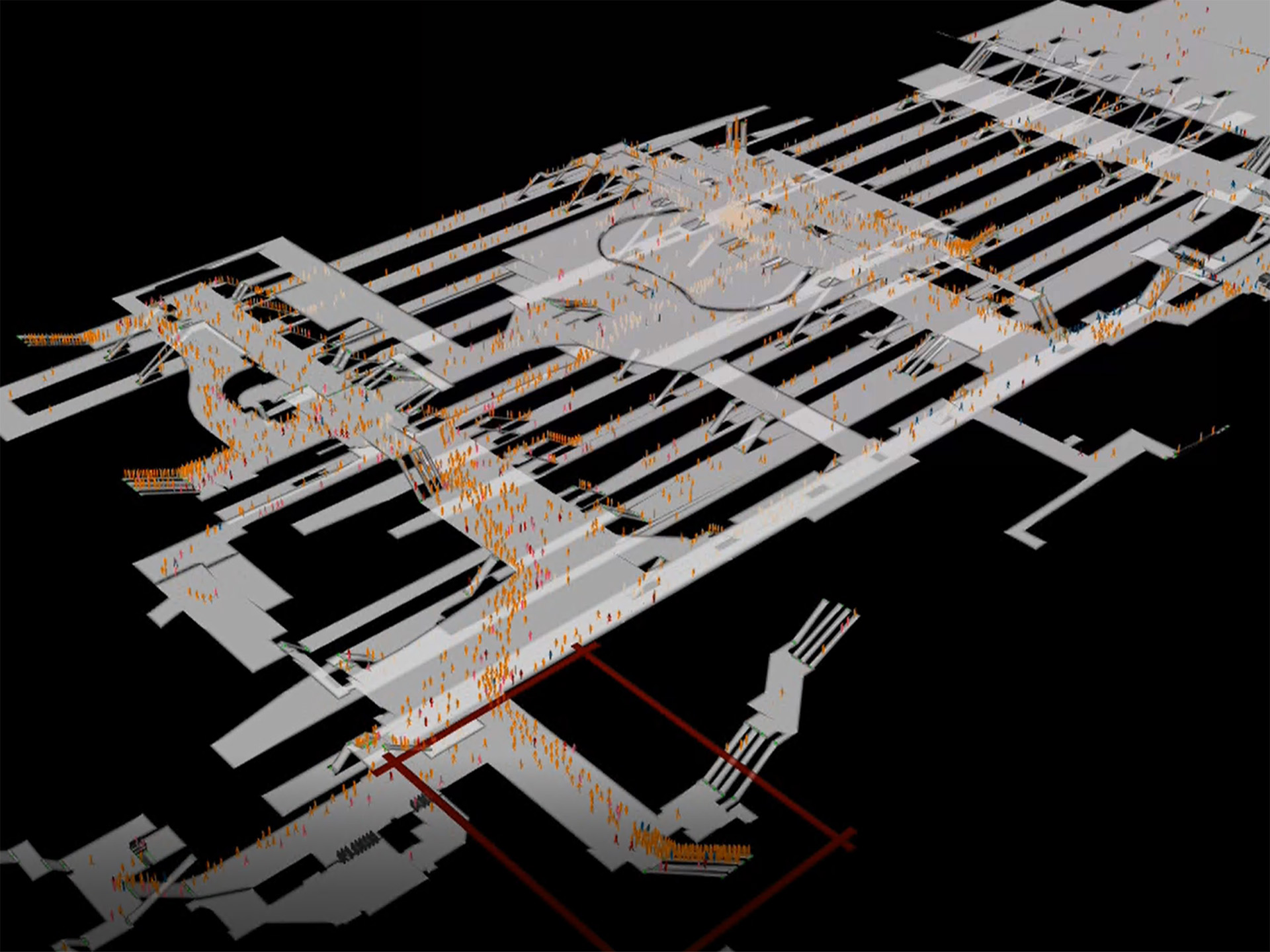
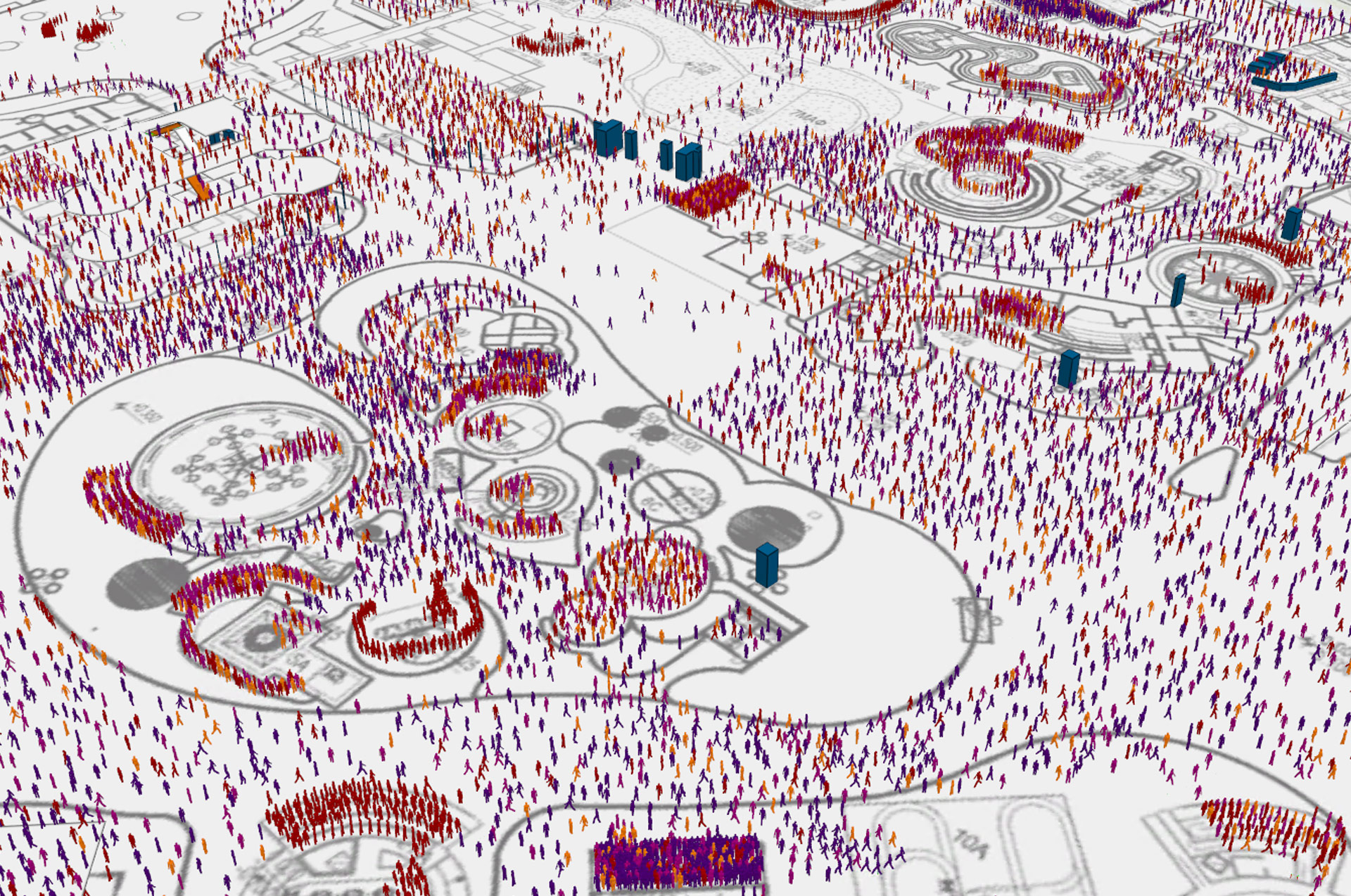
Pedestrian models simulate the detailed movement and behaviour of people within public spaces and enclosed infrastructures. These spaces include railway stations, public transport stops, multimodal hubs, shopping centres, event venues, and high-density urban areas.
They can reproduce various dynamics such as crowd behaviour, slowdowns, interactions between individuals, congestion phenomena, route choice and walking times, enabling the assessment of capacity, levels of service, and safety conditions.
Read moreThe models are essential for analysing evacuations, verifying the usability of spaces, optimising layouts and pedestrian routes, ensuring universal accessibility, and enhancing the user experience in environments with high pedestrian traffic.
Thanks to their ability to realistically reproduce collective behaviour, they support design and operational decisions in complex contexts with high pedestrian flows. Pedestrian models also enable the evaluation of pedestrian space in terms of quality, perceived comfort and the overall user experience.
Read lessCrowd simulation
Pedestrian flow analyses
Pedestrian Level of Service (LOS)
Space dimensioning
Safety assessment
Quality of pedestrian spaces
Universal accessibility
See the projects
Analytical Models
Analytical models are based on formulas and calculation methodologies developed by various institutions over time in accordance with guidelines like the U.S. HCM and the U.K. DMRB.
These models enable a performance evaluation of intersections and infrastructure through consolidated mathematical frameworks, without relying on dynamic simulations. These frameworks can be applied manually using spreadsheets, or implemented through dedicated software such as Sidra, Arcady, Linsig and other capacity analysis tools that automate calculation procedures.
Read moreThe models provide numerical outputs on capacity, levels of service, delays and waiting times, but they do not graphically represent user behaviour or their interactions.
As analytical models are faster to apply, they are useful for preliminary analyses. They are easier to implement than microscopic models and are more simplified, but they still enable a solid and reliable assessment of road performance.
Read lessIntersection analysis
Delay and waiting time calculation
Roundabout capacity assessment
Signal optimisation
Lane capacity calculation
See the projects